
Businesses often have more data than they can use — and more AI opportunities than they know how to prioritise.
We start with the business problem and the underlying data. AI is introduced where it genuinely improves the system or workflow.
AI is everywhere. Not every problem needs it.
None of these are wrong on their own — they’re just not, by themselves, a reason to build with AI.
- removeSomeone wants to add AI because competitors are talking about it.
- removeThere's more data than anyone has time to turn into a decision.
- removeManual knowledge work is consuming time that could go elsewhere.
- removeUseful information exists, spread across systems that don't make it easy to use.
- removeThere are several possible AI ideas, and no clear way to prioritise between them.
- removeA prototype looks impressive in a demo but doesn't fit how the work actually happens.
None of this means AI is overhyped. It means AI becomes valuable when it solves something real — and that’s worth working out before building anything.
Start with the problem, not the model.
Every engagement starts the same way, regardless of whether AI ends up involved at all: understand the business problem, look at the data underneath it, understand the workflow it sits inside, and only then ask what technology — conventional software, integration, automation, or AI — actually fits. The sequence is consistent: business problem → data → workflow → the right technology → AI where useful → validation → production. AI isn’t introduced because it’s fashionable, because it looks impressive in a demo, or because someone asked for “an AI feature.” It’s introduced when it improves a real part of the system.
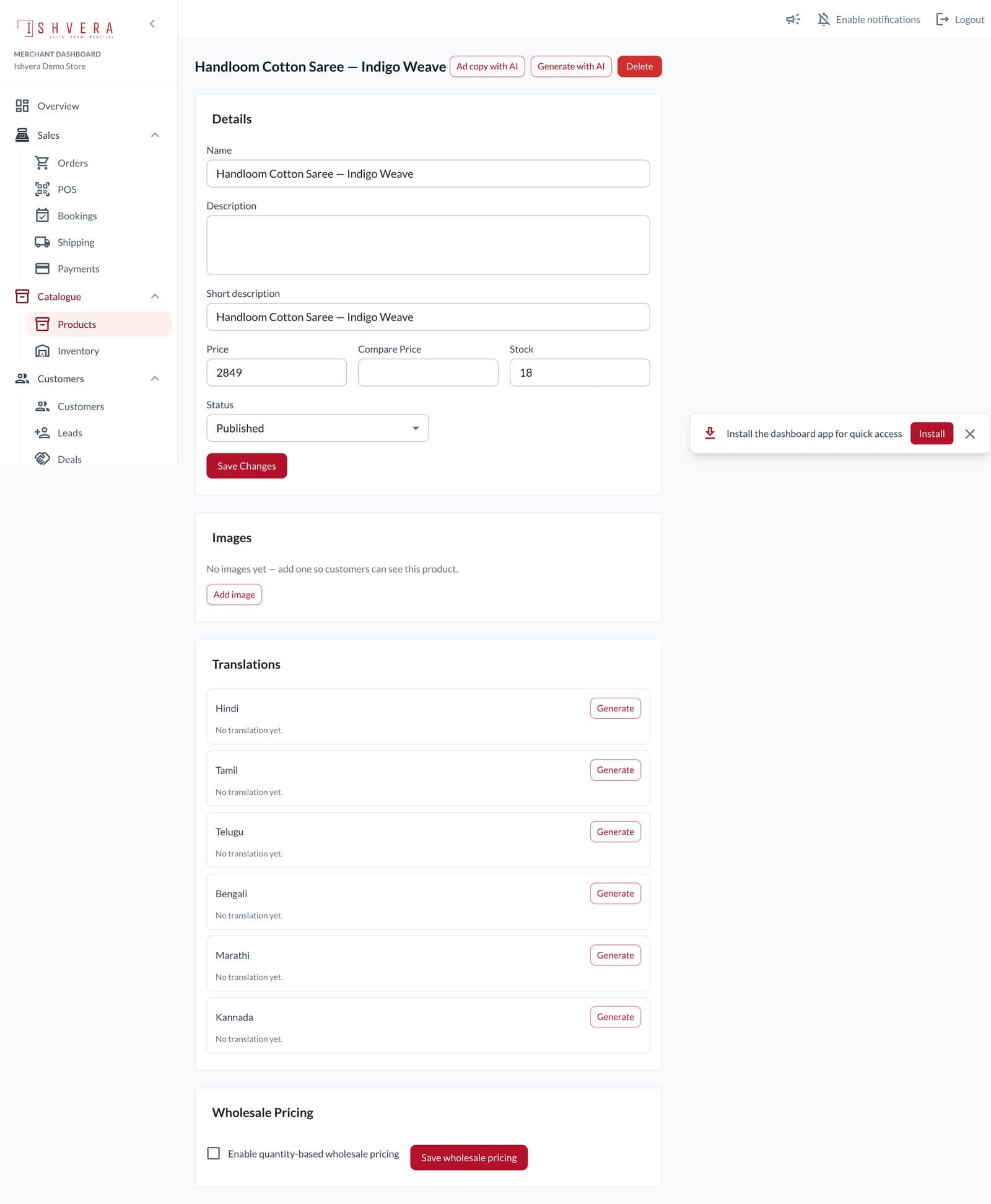
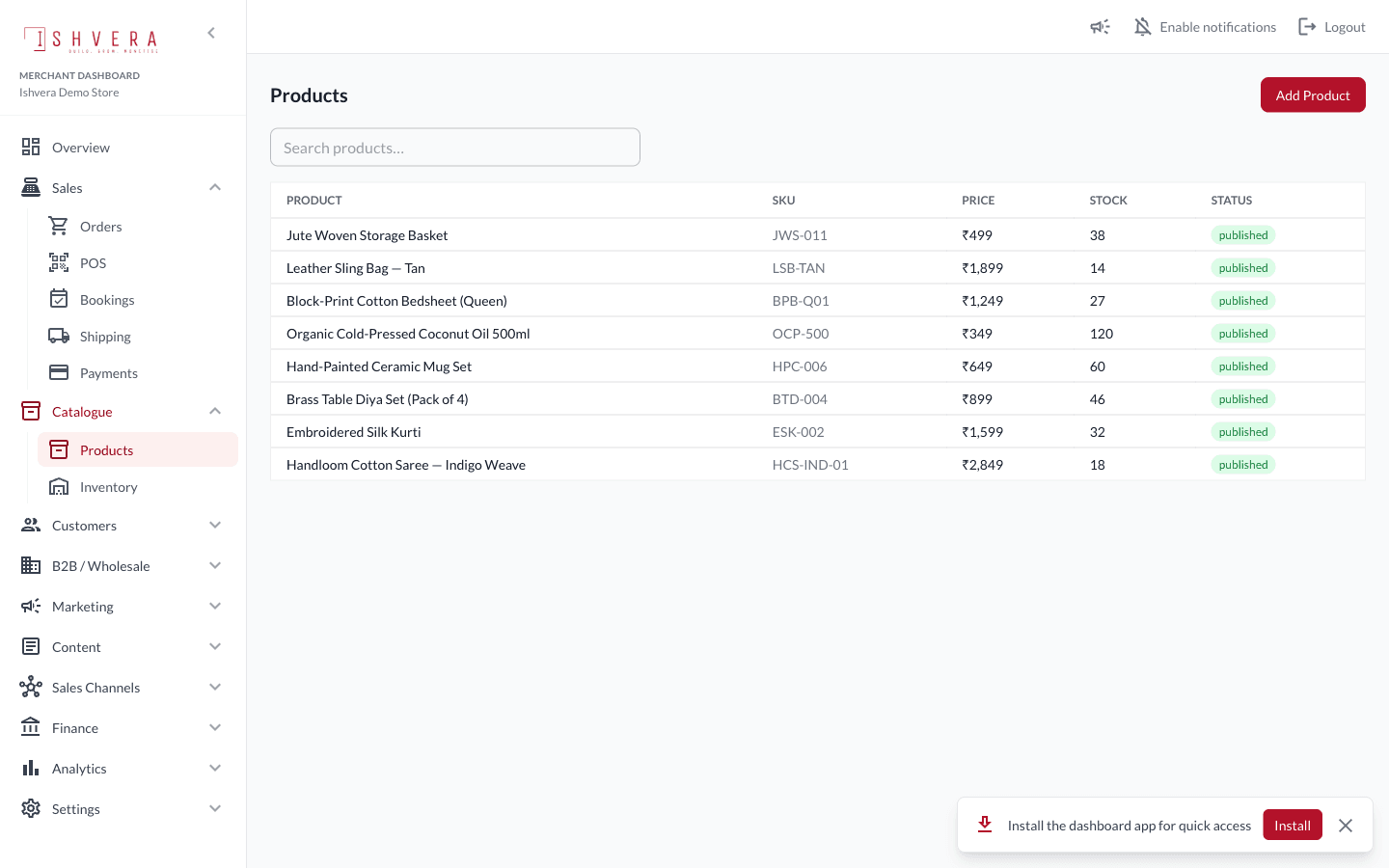
The clearest example of this working is Ishvera Store’s product-listing tool — it’s useful because it sits inside a system that already understands what a product listing needs to contain, who’s going to read it, and what happens next in the order pipeline. Strip the surrounding system away and the same AI feature is a novelty, not a capability.
Read more on why AI won’t fix your business problems on its own →Before AI, there’s data — and it usually needs work first.
AI can only work with the data it’s given. If that information is scattered across systems, inconsistent between them, poorly structured, or nobody’s quite sure which version is correct, no model changes that — it just produces a confident-sounding answer built on an uncertain foundation. Before AI adds value, the more useful questions are usually about the data itself: where does it actually live, who owns it, who’s allowed to see it, and does it mean what everyone assumes it means.
The Ishvera Store Example
Ishvera Store’s product-listing AI works from data that’s already structured — a name, a price, a category, a set of images — inside a system that understands what those fields mean and where the result needs to go. That structure is what makes the AI output usable rather than another paragraph to fact-check.
Real, shipped evidence
What we’ve actually built AI into
Not a feature catalogue — the categories below are the ones we have real, shipped evidence for. Where we don’t, we say so rather than pad the list.
Content generation from structured data
Writing a product description from a name, category, and a few real attributes — instead of a merchant writing every listing from scratch.
Localisation
Generating that same listing in Hindi, Tamil, Telugu, Bengali, Marathi, and Kannada, so a merchant doesn't need six separate translation efforts to reach customers in their own language.
That’s the category we can point to and show you working today. Where a new engagement calls for something outside it — classification, search, workflow assistance — we’ll evaluate it the same way: starting with the problem and the data, not the model.
Real, shipped — not a demo
Product listings, written and translated into six Indian languages, from inside the dashboard.
Product listings can be written and translated into six Indian languages from inside the dashboard — a real, shipped feature, not a demo. It exists because merchants asked for it, not because we wanted an AI feature on the page.
The same panel also generates ad copy — the tools sit together because they solve the same underlying problem: turning one structured product record into the different text a merchant needs across the storefront and their marketing.
An AI feature is one component, not a standalone layer.
A model that writes a good product description still needs somewhere to store it, a permission system that decides who can trigger it, an interface a merchant actually uses, logic that decides what happens to the result, and monitoring that shows us if it stops working. In practice that means data, interfaces, permissions, workflow logic, monitoring, security, a way for a person to review the result, and the ordinary production infrastructure everything else on this site describes. None of that is optional just because AI is involved — if anything, it matters more, because a silent failure in an AI feature looks like a plausible answer instead of an obvious error.
AI outputs need a place to be wrong safely.
A model can produce an incorrect or unexpected output — that’s a property of the technology, not a flaw specific to one implementation. What matters is whether the system around it accounts for that: sensible boundaries on what the model is allowed to do unsupervised, validation before an output reaches a customer or a record that matters, monitoring that surfaces when something looks wrong, and a clear place for a person to review or override the result. We don’t promise an AI feature will never be wrong. We build so that when it is, it’s caught somewhere that isn’t your customer.
See the engineering standard this is held to →AI touches business and customer information — that has to be handled carefully.
Whenever AI works with business or customer data, access control isn’t optional — a feature that generates a product listing has to reach exactly the data it needs and nothing more, behind the same authentication and role-based access as the rest of the system. In a multi-tenant platform like Ishvera Store, that’s the difference between a platform and a liability: one merchant’s data must never reach another’s, or an AI feature working on it, by design, not by hope.
A demo and a production feature are not the same achievement.
Almost anyone can produce an impressive AI demo now — that part has gotten easy. The harder question is whether it survives contact with the real business: does it fit inside the actual workflow, does it have appropriately scoped access to real data, can it be monitored once it’s live, can it be tested before a change ships, and does it have a defined, permanent place in the product rather than living as a one-off script somebody has to remember to run. That gap — between a compelling prototype and something a business can actually depend on — is most of the real work.
Use AI where it adds intelligence. Use simpler technology where simpler technology is enough.
Not every workflow needs AI. Sometimes the right answer is better data, better integration, a clearer workflow, a better interface, straightforward automation, search, or a conventional software feature — and any of those can be the more honest, more reliable, cheaper answer. AI is one option among several, not the default one. We’d rather tell a client the problem doesn’t need AI than build a feature that exists mainly to say we did.
See where automation earns its place too →Why not just add an AI feature yourselves?
Because the model is rarely the hard part. The hard part is understanding the business problem well enough to know if AI is the right answer, having the data in a state where AI can actually use it, building the workflow and interface around it properly, and holding the result to the same security and production standard as everything else on this site. Deepak leads every engagement personally, bringing in specific technical expertise project by project, so an AI feature gets built inside a real system — not delivered as a standalone experiment.
How we’re built →What happens after “yes”
Not every engagement follows this path exactly, and not every AI idea makes it past validation — that’s the point of having one. We determine whether there’s something worth building before assuming there is.
See how we work →Where we’re probably not the right fit
— You want AI added because it's fashionable, not because there's a business problem behind it.
— The request is for “an AI feature” with no clear problem it's meant to solve.
— A conventional software solution would clearly work better, but AI has already been decided on regardless.
— The goal is an impressive demo, not something that has to keep working in production.
— There's no willingness to share the information we'd need to actually evaluate the problem.
Have an AI idea — or a problem you think AI might solve?
Tell us what you're trying to improve. We'll help determine whether AI is actually the right answer.